
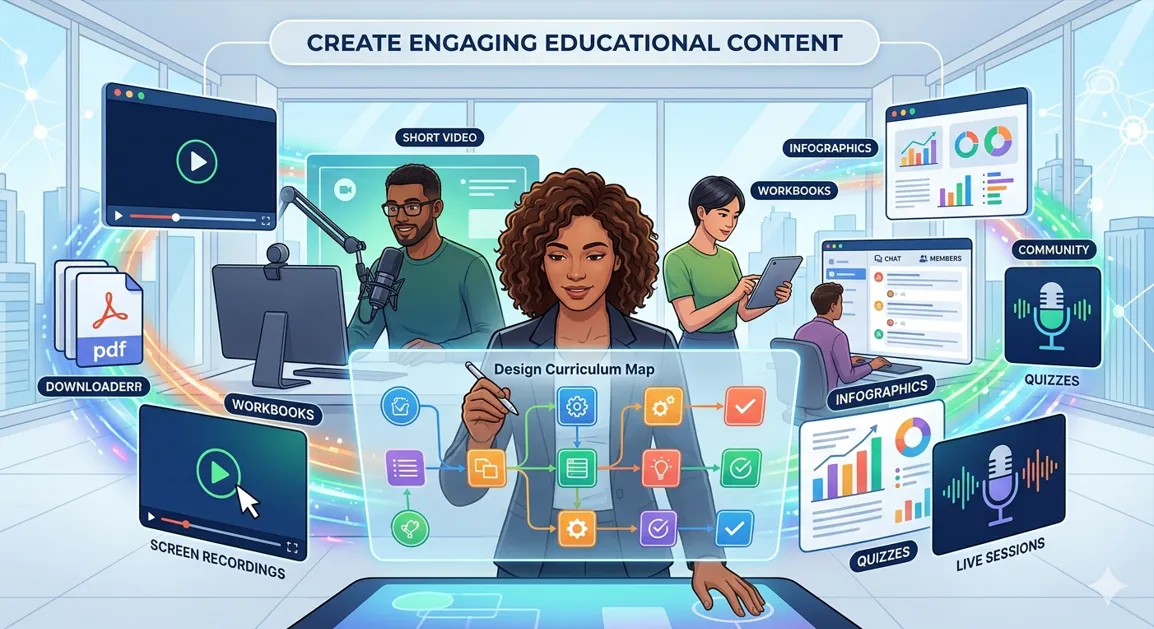
Engaging educational content is the foundation of every successful online course. You might have great knowledge and a strong sales funnel. However, if your content fails to hold attention, students drop off fast. They stop watching, ask for refunds, and never come back.
The great news is that creating content people love to learn from is a skill you can build. Moreover, it does not require a fancy studio or a big budget. It simply requires the right structure, the right tools, and a clear plan. So, whether you are launching on Kajabi or building a community on Skool, this guide shows you exactly what to do.
What Is Engaging Educational Content?
Engaging educational content is any learning material that holds attention, builds understanding, and drives real action. It goes far beyond filming yourself talking about a topic. Instead, it blends clear structure, relevant examples, varied formats, and a tone that respects the learner’s time.
On online platforms, engaging content typically means:
- Lessons that are short, focused, and easy to follow
- Material tied directly to what the student wants to achieve
- A mix of video, visuals, text, and hands-on exercises
- A logical flow that builds student confidence step by step
- Regular checkpoints so students can track their own progress
Furthermore, strong engaging educational content drives word-of-mouth referrals, great reviews, and high completion rates. These three things grow your course business faster than any paid ad campaign ever will.
Why Most Course Content Fails to Engage Students
Before building great content, it helps to understand why so much online course content falls flat. Many creators make the same avoidable mistakes. Recognizing them early saves you time and lost revenue.
Here are the most common reasons course content loses student engagement:
- No clear learning objective: students do not know what each lesson will give them
- Lessons are too long: videos over fifteen minutes cause attention to drop sharply
- Only one format used: watching talking-head videos back to back quickly becomes exhausting
- Too much theory: learners want to do things, not just hear about them
- No logical order: jumping between unrelated topics confuses students and breaks trust
- No assessments: without checkpoints, students lose direction and stop progressing
- Passive delivery: reading from slides with no energy makes students zone out fast
Therefore, fixing these problems is not about working harder. It is about designing your content smarter from the very start.
Step-by-Step Guide to Creating Engaging Educational Content
Step 1: Define Your Learning Outcomes First
Every piece of engaging educational content begins with one clear question: What should the student be able to do after this lesson? This outcome drives every decision you make, including content, format, length, and assessment.
Use action verbs to write clear, measurable outcomes. For example:
- Rather than saying “understand budgeting,” use: “Students will build a monthly budget using the 50/30/20 rule.”
- In place of “learn about AI,” write: “By the end, students will set up their first AI content workflow in thirty minutes.”
- For “know about funnels,” try: “This lesson guides students to create a two-step opt-in funnel using ClickFunnels.”
Additionally, writing outcomes first helps you cut content that does not serve the student’s goal. Consequently, your lessons become tighter, more focused, and far more satisfying to complete.
Step 2: Build a Logical Curriculum Structure
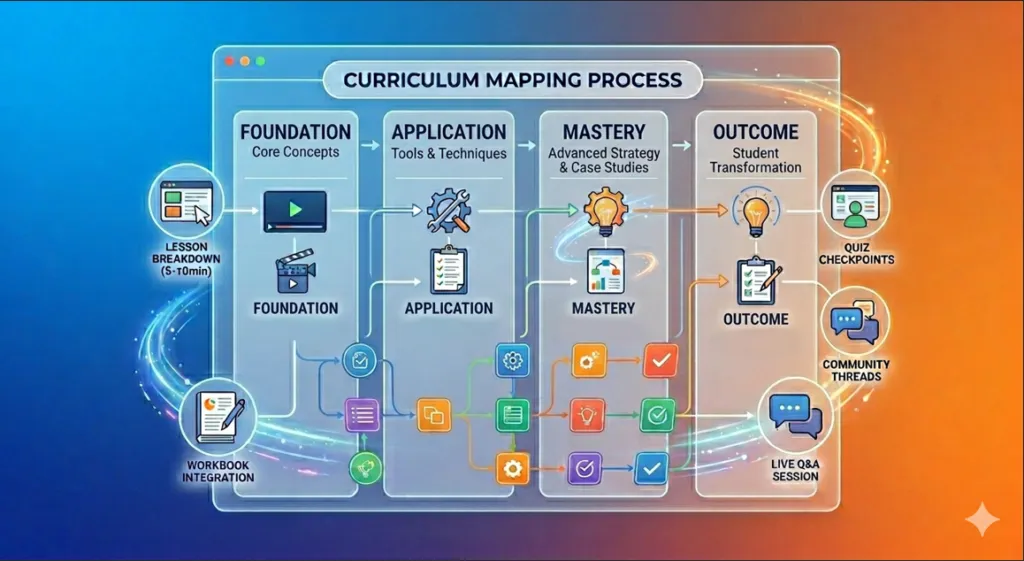
Good curriculum design is the backbone of all engaging educational content. Even great lessons fail when they appear in the wrong order. Therefore, before recording anything, map out your full course structure in a simple tool like Notion or Google Docs.
A three-phase structure works well across almost every niche:
- Foundation: Introduce core ideas, key vocabulary, and mindset shifts
- Application: Teach frameworks, tools, and hands-on practice
- Mastery: Cover advanced strategies, real-world case studies, and troubleshooting
Moreover, grouping related lessons into themed modules gives students a clear sense of progress. Each module they finish feels like a real win. That feeling of achievement keeps them moving forward through the rest of your course.
Step 3: Keep Every Lesson Short and Focused
One of the fastest ways to boost engagement is to shorten your lessons. Research consistently shows that videos between five and ten minutes achieve much higher completion rates than longer recordings. Students are busy and watching between meetings, on phones, or during lunch breaks.
Follow this simple rule: one lesson, one idea. If a lesson covers three concepts, split it into three separate lessons. This also makes updating your course much easier later on.
Additionally, open every lesson with a one-sentence outcome. That single line tells students exactly what they are about to learn. It reduces anxiety and increases focus right from the start.
Step 4: Use Multimedia to Hold Attention
Relying only on talking-head videos is the quickest way to lose your audience. Effective engaging educational content uses several formats to suit different learning styles and keep the course experience fresh throughout.
Consider adding these formats to your course:
- Screen recordings: show students how to complete real tasks in tools like Kajabi or ClickFunnels
- Downloadable workbooks: give students something to fill in and keep as a reference guide
- Infographics and slides: ideal for summarizing frameworks and key statistics visually
- Audio-only lessons: great for students who prefer listening on the go
- Community threads: platforms like Skool enable peer learning that deepens understanding
- Live Q&A sessions: create real-time connection and answer questions your content may miss
- Checklists and templates: help students take action immediately without starting from scratch
Furthermore, using multiple formats signals that you have thought carefully about your students’ experience. That care builds trust, and trust is what keeps students enrolled and referring others.
Step 5: Simplify Complex Topics the Right Way
Many creators teach the way they were taught in school, dense, jargon-heavy, and theory-first. However, online learners expect content that respects their time and meets them where they are. Therefore, simplifying hard topics is one of the most powerful skills you can develop.
These techniques work well for making complex content easy to understand:
- Analogies: connect new ideas to things the student already knows well
- Chunking: break large topics into small, focused pieces taught one at a time
- Scaffolding: start simple and add complexity gradually across multiple lessons
- Show before tell: demonstrate a real example first, then explain the principle behind it
- Plain language: introduce technical terms only after the student grasps the core idea
For instance, if you are teaching financial literacy to beginners, do not open with compound interest formulas. Instead, start by showing what happens when someone saves one hundred dollars a month for ten years. This way, the idea feels real and easy to grasp. Then, once the student is engaged and curious, you can introduce the formula later.
Step 6: Add Assessments That Reinforce Learning
Assessments are not just tests. They are among the most effective tools for creating truly engaging educational content. When students apply what they have learned, they retain it far longer and feel real confidence in their skills.
These assessment types work well in online courses:
- Short quizzes: two to five questions per module reinforce key concepts quickly
- Action tasks: “complete this one step before the next lesson” creates accountability
- Reflection prompts: asking students to write one takeaway deepens comprehension
- Peer reviews: especially powerful in community formats on Skool
- Capstone projects: a final project gives students a tangible result they are proud of
Additionally, assessments give you data as the course creator. Consequently, you can see where students struggle, improve those lessons, and deliver a stronger course with every cohort you run.
Engaging Educational Content Formats at a Glance
| Format | Best Use | Platform | Engagement Impact |
|---|---|---|---|
| Short video lessons | Core concept teaching | Kajabi, Skool, Teachable | High — best for retention |
| Downloadable workbooks | Hands-on application | All platforms | High — drives action |
| Screen recordings | Software tutorials | Loom, Kajabi | Very high for tech topics |
| Infographics | Framework summaries | Canva, Kajabi | Medium — supports recall |
| Community threads | Peer learning and Q&A | Skool, Kajabi | High — builds belonging |
| Quizzes and tasks | Knowledge reinforcement | Kajabi, Thinkific | High — boosts completion |
| Live sessions | Real-time Q&A | Zoom, Skool | Very high — builds trust |
How to Apply This in Popular Course Niches
Financial Literacy Courses
Teaching money topics requires extra care because finances are emotionally loaded for many students. People often arrive with shame or anxiety around money. Therefore, your content should build psychological safety before introducing any numbers or frameworks.
A strong content structure for financial literacy courses:
- Open with relatable stories and real scenarios, not statistics or formulas
- Introduce vocabulary in plain English before using any technical terms
- Pair each lesson with a simple, immediate action step
- Build gradually toward budgeting systems, investing basics, and debt payoff plans
- Use downloadable templates so students can apply lessons the same day they watch
AI Certification and Technology Courses
AI certification is one of the fastest-growing course niches in 2026. However, the subject feels intimidating to many beginners. Consequently, the best engaging educational content in this space starts with everyday analogies before introducing any technical vocabulary.
For example, explain machine learning by comparing it to how Netflix learns your movie preferences. Then gradually introduce terms like training data, model, and prediction. This scaffolding approach makes the content feel approachable, and dramatically increases how far students progress through your course.
Business and Funnel-Building Courses
For courses built around ClickFunnels or digital product launches, learners want fast, visible results. Hence, every lesson should include an immediate action step. After a lesson on lead magnets, for example, the task might be: “build your opt-in page using the template in this lesson.” This applied approach to engaging educational content keeps students moving forward because they see real progress, not just theory building up.
Best Tools for Creating Engaging Educational Content in 2026
You do not need expensive gear to create high-quality content. The right tools, used well, make all the difference:
- Kajabi: all-in-one platform for hosting, drip content, quizzes, and email automation
- Skool: best for community-based learning and cohort course formats
- Loom: fast, professional screen recording and talking-head video without a studio
- Canva: easy creation of workbooks, infographics, and slide decks
- Notion: simple and effective for planning your curriculum before you start recording
- ClickFunnels: connects your course directly to a high-converting sales funnel
- Descript: edit video like editing a text document, saving hours of production time
If you are ready to launch, check out our digital product launch guide to connect your content strategy with your sales plan.
References
Association for Talent Development (ATD)https://www.td.org/talent-development-glossary-terms/what-is-instructional-design The world’s leading organization for learning and talent development publishing peer-reviewed research and standards on instructional content design
eLearning Industry – eLearning Content Development https://elearningindustry.com/elearning-content-development One of the most widely read publications covering online course creation, multimedia learning strategies, and instructional design best practices for digital educators
Conclusion
Creating engaging educational content is not about being the most entertaining person on screen. It is about understanding what your students need, structuring your content to deliver it clearly, and using the right mix of formats to keep attention from the first lesson to the last. Therefore, start by writing clear learning outcomes. Then build a logical curriculum, keep your lessons short, add practical tasks, and use platforms like Kajabi and Skool to deliver the experience your students deserve. When you get this right, higher completion rates, stronger reviews, and more referrals follow naturally
Frequently Asked Questions
Q1. What makes educational content truly engaging for online learners?
Engaging educational content is short, clearly structured, and tied to a specific outcome. It uses varied formats and practical tasks that give students something to do not just watch.
Q2. How long should each lesson be in an online course?
Aim for five to ten minutes per video. Shorter lessons improve completion rates and make it easy for students to revisit specific content without rewatching a long recording.
Q3. Which platform is best Kajabi or Skool?
Kajabi suits structured, self-paced courses with drip content and quizzes. Skool works better for community-driven or cohort-based formats. Your choice depends on your course style and audience.
Q4. How do I stop students from dropping off mid-course?
Use short lessons, regular action tasks, and community interaction to keep momentum strong. Additionally, progress-based email reminders through Kajabi help bring inactive students back at the right time.
Q5. Do I need expensive equipment to create professional content?
No. A good USB microphone, natural lighting, and tools like Loom or Descript are more than enough. Audio quality matters far more than video quality for most online learners.
Q6. How many formats should I use in one course?
Aim for at least three video, a downloadable resource, and a quiz or community element. Variety holds attention and ensures you reach different types of learners throughout your course.
Q7. Can AI tools help me create content faster?
Yes. AI tools help you outline lessons, write quiz questions, and generate workbook prompts quickly. Use them to speed up production while you focus on your unique teaching expertise and strategy.
Q8. What role does instructional design play in engaging content?
Instructional design gives your content a clear framework so it achieves real learning outcomes. Without it, even the most knowledgeable creators produce lessons that feel disorganized and fail to drive real student results.
Authored by: Laiba Ayaz