What separates average courses from those that truly deliver results? The answer lies in Instructional Design Secrets time-tested, research-backed strategies drawn from decades of studies in journals such as the British Journal of Educational Technology, Australasian Journal of Educational Technology, Educational Technology & Society, The Internet and Higher Education, and resources from ERIC, ATD, Gartner, LinkedIn Workplace Learning Reports, and more.
These Instructional Design Secrets go far beyond basic templates or flashy visuals. They represent deliberate, evidence-based practices that transform passive content into transformative learning experiences. In this comprehensive guide, we explore eight proven secrets, supported by research, with practical implementation tips you can apply immediately.
Whether you design courses for higher education, corporate training, or professional development, mastering these secrets will help you create learning experiences that learners complete, remember, and most importantly apply in real life.
Secret 1: Begin with Deep Learner Analysis and Crystal-Clear Objectives
Every successful course starts with thorough front-end analysis. Skipping this step is one of the most common reasons courses fail to convert. You must understand your learners’ needs, prior knowledge, motivations, challenges, and preferred learning styles before designing a single module.
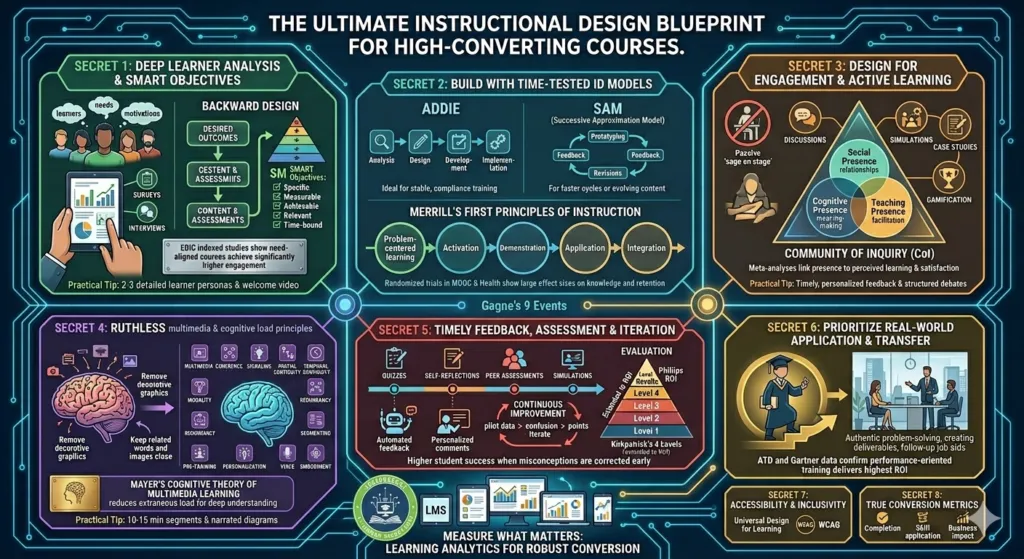
Use tools like surveys, interviews, and learner personas to gather data. Then, apply backward design: start with the desired outcomes and work backward to create content and assessments that support those goals. Frame objectives using Bloom’s Taxonomy to ensure they are specific, measurable, achievable, relevant, and time-bound (SMART).
Research consistently supports this approach. Studies indexed in ERIC and published in educational technology journals show that courses built on solid learner analysis achieve significantly higher engagement and lower dropout rates. For example, needs-aligned courses reduce attrition by helping learners see immediate relevance to their personal or professional goals.
Practical Tip: Create 2–3 detailed learner personas. Record a short welcome video that speaks directly to their pain points and aspirations. Establishing instructor presence early builds trust and motivation a factor linked to better persistence in online environments.
Investing time here pays dividends throughout the course lifecycle. Without clear objectives, learners feel lost; with them, every element of the course feels purposeful.
Secret 2: Build Courses Using Time-Tested Instructional Design Models
Avoid reinventing the wheel. Leverage established instructional design models that have been refined through years of research and real-world application.
The classic ADDIE model (Analysis, Design, Development, Implementation, Evaluation) provides a systematic, linear framework ideal for complex or compliance-heavy programs. It ensures nothing is overlooked and supports thorough documentation.
For faster development cycles or evolving content, consider the SAM (Successive Approximation Model). SAM is iterative and agile, involving rapid prototyping, stakeholder feedback, and quick revisions — making it more flexible than ADDIE when timelines are tight or requirements change frequently.
Another powerful framework is Merrill’s First Principles of Instruction. This research-based model emphasizes five core principles:
- Problem-centered learning (learning is promoted when learners solve real-world problems)
- Activation of prior knowledge
- Demonstration of new knowledge/skills
- Application of new knowledge/skills
- Integration into the learner’s world
Multiple studies, including randomized trials in health education and MOOC environments, demonstrate that courses designed with Merrill’s principles lead to significantly higher knowledge gains, retention, and learner satisfaction compared to traditional approaches. One study reported a 42% knowledge improvement in the Merrill-based group versus 25% in controls, with large effect sizes.
Gagné’s Nine Events of Instruction offers another sequencing guide: gain attention, inform objectives, stimulate recall, present content, provide guidance, elicit performance, provide feedback, assess performance, and enhance retention/transfer.
Implementation Advice: Choose the model based on project constraints. For stable, high-stakes training, use ADDIE. For rapid corporate upskilling, try SAM combined with Merrill’s principles. Document your choices this transparency helps when measuring ROI later.
Secret 3: Design for Engagement, Not Just Content Delivery
Passive “sage on the stage” content kills conversion. High-converting courses actively involve learners through interaction, collaboration, and meaningful activities.
Incorporate discussions, peer reviews, simulations, case studies, branching scenarios, and gamified elements. These strategies combat the isolation often felt in online learning.
The Community of Inquiry (CoI) framework provides an excellent structure here. It identifies three interdependent presences:
- Social Presence: Learners project themselves as real people and build relationships.
- Cognitive Presence: Learners construct meaning through reflection and discourse.
- Teaching Presence: Instructors design, facilitate, and direct the experience.
Meta-analyses and empirical studies show strong correlations between these presences and outcomes: teaching presence links to actual learning (r ≈ .35), while cognitive presence strongly predicts perceived learning and satisfaction. Social presence enhances engagement and reduces dropout.
Practical ways to build CoI:
- Use icebreakers and introduction forums
- Facilitate structured debates or group projects
- Provide timely, personalized feedback
- Encourage reflective journaling
Research from award-winning online faculty and systematic reviews confirms that courses emphasizing interaction see higher completion rates and deeper learning. Tools like discussion boards, collaborative documents, or live Q&A sessions make a measurable difference.
Pro Tip: Balance synchronous and asynchronous activities. Even fully asynchronous courses can feel connected when social and teaching presence are intentionally designed.
Secret 4: Apply Cognitive Load and Multimedia Principles Ruthlessly
Learners have limited working memory. Overload it, and engagement plummets. This is where Cognitive Load Theory and Richard Mayer’s Cognitive Theory of Multimedia Learning become indispensable Instructional Design Secrets.
Mayer’s 12 principles (updated over years of empirical research) guide effective use of words and pictures:
- Multimedia Principle: People learn better from words + pictures than words alone.
- Coherence Principle: Remove extraneous material — no decorative graphics or unrelated stories.
- Signaling Principle: Highlight essential material with cues (arrows, bold text, voice emphasis).
- Contiguity Principles (Spatial & Temporal): Keep related words and images close together and presented simultaneously.
- Modality Principle: Use narration with visuals rather than on-screen text (when possible).
- Redundancy Principle: Avoid duplicating narration with identical on-screen text.
- Segmenting Principle: Break complex content into learner-paced segments.
- Pre-training Principle: Provide key concept overviews before deep dives.
- Personalization, Voice, and Embodiment Principles: Use conversational style, friendly human voice, and on-screen agents when appropriate.
These principles reduce extraneous cognitive load, manage essential processing, and promote generative processing (deeper understanding). Studies across e-learning, augmented reality, and traditional presentations consistently show improved outcomes when applied.
Practical Application:
- Chunk modules into 10–15 minute segments
- Use clean visuals that directly support the message
- Replace long text slides with narrated diagrams
- Test your materials with real learners to identify overload points
Quality Matters rubrics and cognitive load research in blended learning environments reinforce that well-designed multimedia leads to better persistence and performance.
Secret 5: Embed Timely Feedback, Assessment, and Iteration
Assessment should never be an afterthought. High-converting courses integrate formative (ongoing) and summative (end-of-unit) assessments with immediate, specific feedback.
Use quizzes, simulations, peer assessments, and self-reflections throughout. Automated feedback works for simple checks; personalized instructor or AI-supported comments add depth for complex tasks.
The final phase of ADDIE Evaluation emphasizes continuous improvement. Pilot your course with a small group, collect data on completion, confusion points, and satisfaction, then iterate.
Studies on continuous improvement in online education link iterative design to higher student success. Feedback-rich environments boost motivation and help learners correct misconceptions before they solidify.
Kirkpatrick’s Four Levels (Reaction, Learning, Behavior, Results) sometimes extended to Phillips ROI (Level 5) provide a framework for evaluating beyond simple smile sheets. Track not just “Did they like it?” but “Did they apply it?” and “Did it impact business/educational outcomes?”
Actionable Steps:
- Build in low-stakes quizzes after each major concept
- Use rubrics for assignments with clear criteria
- Schedule mid-course surveys and make visible changes based on feedback
- Analyze learning analytics from your LMS to spot drop-off points
Secret 6: Prioritize Real-World Application and Transfer
The ultimate measure of conversion is transfer learners actually using new knowledge and skills in their jobs or lives.
Merrill’s principles stress application and integration. Design activities where learners solve authentic problems, create deliverables, or role-play scenarios relevant to their context.
In corporate settings, align content tightly with job performance needs. Research from Gartner, Brandon Hall Group, and ATD shows that performance-oriented training delivers the highest ROI.
Include capstone projects, action plans, or “commitment to apply” reflections at the end of modules. Follow-up micro-learning boosters or job aids months later can sustain transfer.
Secret 7: Make Accessibility and Inclusivity Non-Negotiable
Universal Design for Learning (UDL) and WCAG compliance are ethical and practical imperatives. Offer multiple means of engagement, representation, and expression.
Provide captions, transcripts, alt text, keyboard navigation, and flexible pacing. Inclusive design benefits everyone not just learners with disabilities by improving usability and engagement.
Studies show accessible courses reach broader audiences and often achieve better overall outcomes.
Secret 8: Measure What Matters True Conversion Metrics
Track meaningful data:
- Completion and retention rates
- Pre/post knowledge assessments
- Skill application (Level 3 Behavior)
- Business/educational impact (Level 4 Results)
- Financial ROI where applicable (Level 5)
Use LinkedIn Workplace Learning insights, ATD benchmarks, and your LMS analytics. Compare trained vs. untrained groups when possible.
Data-driven iteration turns good courses into exceptional ones over time.
Putting These Instructional Design Secrets into Practice
These eight Instructional Design Secrets are not theoretical they are battle-tested across higher education and corporate environments. Start by auditing one existing course against this framework. Identify gaps in analysis, engagement, cognitive load management, or evaluation. Then redesign using ADDIE or SAM as your backbone, Merrill’s principles for content structure, CoI for community, and Mayer’s guidelines for multimedia.
Expect iterative work. The most successful courses evolve based on real learner data.
By applying these secrets systematically, you will create courses that:
- Achieve higher completion rates
- Deliver deeper learning
- Drive measurable behavior change
- Generate strong ROI for stakeholders
Great instructional design is both science and craft. It requires empathy for learners, rigor in process, and commitment to evidence. Master these Instructional Design Secrets, and your courses will stop merely existing they will truly convert.
Conclusion
Mastering Instructional Design Secrets is the definitive way to move beyond simply building courses to creating learning experiences that truly convert. In a world overflowing with educational content, only those courses designed with intention grounded in research from top educational technology journals, cognitive science, and proven L&D frameworks achieve high completion rates, deep engagement, lasting retention, and measurable behavior change.
By applying the eight Instructional Design Secrets outlined in this guide, you can systematically transform your courses:
- Start with thorough learner analysis and clear objectives
- Leverage established models like ADDIE, Merrill’s First Principles, and Gagné’s Nine Events
- Prioritize active engagement through the Community of Inquiry framework
- Ruthlessly apply Cognitive Load Theory and Mayer’s Multimedia Principles
- Build in continuous feedback, assessment, and iteration
- Focus on real-world application and transfer of learning
- Ensure accessibility and inclusivity for all learners
- Measure what truly matters using Kirkpatrick’s levels and ROI metrics
These Instructional Design Secrets are not quick fixes or trendy hacks they are evidence-based practices that have been refined over decades and continue to deliver results in both higher education and corporate training environments.
At TheEduAssist, we live these Instructional Design Secrets every day. As a specialized eLearning agency, we partner with businesses, educational institutions, and EdTech providers to design and develop custom courses that don’t just look good they perform. Our team combines deep expertise in instructional design with modern tools, AI-powered solutions, and user-centered development to create engaging, effective, and scalable learning experiences.
Whether you need a complete course redesign, full custom eLearning development, or expert guidance to implement these Instructional Design Secrets in your organization, TheEduAssist is ready to help you achieve outstanding results.
Stop creating courses that learners abandon. Start building ones that convert with higher completion rates, stronger outcomes, and real ROI.
References
- Abuhassna, H., et al. (2024). Exploring the synergy between instructional design models and learning theories: A systematic review. Contemporary Educational Technology. PDF
- Badali, M., et al. The effects of using Merrill’s first principles of instruction on participants’ learning and satisfaction in MOOCs. Link
- Gagné, R. M. (1985). The conditions of learning and theory of instruction (4th ed.). Holt, Rinehart and Winston.
- Gardner, J. L. (2011). Testing the efficacy of Merrill’s First Principles of Instruction in improving student performance in introductory biology courses [Doctoral dissertation]. Utah State University. PDF
- Garrison, D. R., Anderson, T., & Archer, W. (2000). Critical inquiry in a text-based environment: Computer conferencing in higher education. The Internet and Higher Education, 2(2-3), 87–105. PDF
- Kirkpatrick, D. L., & Kirkpatrick, J. D. (2006). Evaluating training programs: The four levels (3rd ed.). Berrett-Koehler Publishers. Introduction to the New World Kirkpatrick Model (PDF)
- Lo, C. K. (2018). Applying “First Principles of Instruction” as a design theory of flipped classrooms: A systematic review and meta-analysis. Computers & Education. ScienceDirect
- Martin, F., Wu, T., Wan, L., & Xie, K. (2022). A meta-analysis on the Community of Inquiry presences and learning outcomes in online and blended learning environments. Online Learning, 26(1), 325–359. Full Text
- Mayer, R. E. (2002). Multimedia learning. Cambridge University Press. PDF Excerpt
- Mayer, R. E. (2009). Multimedia learning (2nd ed.). Cambridge University Press.
- Mayer, R. E. (2021). Multimedia learning (3rd ed.). Cambridge University Press.
- Mayer, R. E. (2024). The past, present, and future of the cognitive theory of multimedia learning. Educational Psychology Review. Springer
- Merrill, M. D. (2002). First principles of instruction. Educational Technology Research and Development, 50(3), 43–59. Springer | Full PDF
- Merrill, M. D. (2013). First principles of instruction: Identifying and designing effective, efficient, and engaging instruction. Pfeiffer.
- Özkan, A. (2025). The past and present of instructional design in online learning: Trends and emerging directions. The International Review of Research in Open and Distributed Learning (IRRODL). Full Text
- Sarfi, M., et al. (2025). Effectiveness of Merrill’s first principles training on providers’ knowledge regarding adolescent nutrition. PMC. Full Article
- Sweller, J., Ayres, P., & Kalyuga, S. (2011). Cognitive load theory. Springer. PDF
Additional Industry & Evaluation Sources
- Association for Talent Development (ATD). (2025). 2025 State of the Industry: Talent Development Benchmarks and Trends. ATD Site
- Gartner. (Various years). Corporate learning technologies research and reports. Gartner
- LinkedIn. (2025). Workplace Learning Report 2025. Report Page
- Quality Matters. (n.d.). Higher education course design rubrics and standards. Quality Matters
Frequently Asked Questions (FAQs) about Instructional Design Secrets
1. What are Instructional Design Secrets?
Instructional Design Secrets refer to proven, research-backed strategies and best practices that go beyond basic course creation. They include using established models (like ADDIE and Merrill’s Principles), applying cognitive load theory, designing for engagement, ensuring real-world application, and measuring true learning outcomes. These secrets help create courses that achieve high completion rates and deliver measurable results.
2. Why do most online courses fail to convert, and how can Instructional Design Secrets help?
Many courses suffer from poor learner analysis, passive content, cognitive overload, lack of interaction, and weak assessment. Instructional Design Secrets address these issues directly by focusing on learner needs, active engagement, clear multimedia design, timely feedback, and performance-based outcomes dramatically improving completion rates and learning effectiveness.
3. Which instructional design model should I use for my course?
It depends on your project. Use ADDIE for structured, high-stakes programs. Choose SAM for rapid, iterative development. Incorporate Merrill’s First Principles for problem-centered, application-focused learning. Many successful courses combine elements from multiple models. TheEduAssist can help you select and customize the right approach for your goals.
4. How important is cognitive load theory in modern course design?
Extremely important. Cognitive Load Theory and Mayer’s Multimedia Principles help prevent learner overload, making content easier to process and retain. Applying these Instructional Design Secrets leads to cleaner layouts, better chunking, and higher engagement — essential for today’s short-attention-span digital learners.
5. Can Instructional Design Secrets improve corporate training ROI?
Yes significantly. When courses are designed with real-world application, behavior change measurement (Kirkpatrick Level 3 & 4), and business alignment, they deliver measurable returns. Industry reports from ATD, Gartner, and LinkedIn consistently show that well-designed training yields higher performance impact and ROI.
6. How does TheEduAssist apply Instructional Design Secrets?
At TheEduAssist, we embed these Instructional Design Secrets into every project. From needs analysis and custom instructional design to AI-enhanced development, gamification, and LMS integration, our team creates courses that engage learners and deliver results. We specialize in custom eLearning solutions for businesses, universities, and training providers.
7. Do I need professional help to implement these Instructional Design Secrets?
While you can start applying many secrets yourself, complex projects benefit greatly from expert instructional designers. TheEduAssist offers end-to-end services — including instructional design consulting, full course development, UI/UX design, and ongoing optimization — to ensure your courses perform at the highest level.
8. Where can I learn more or get started with TheEduAssist?
Visit TheEduAssist.com to explore our services, case studies, and blog. You can also reach out directly for a free consultation on how to apply Instructional Design Secrets to your specific training or educational needs.
Authored By: Atiqa Sajid http://www.linkedin.com/in/atiqa-sajid-747b57137