
Across real estate education, brokerships, and training businesses, “Real Estate Virtual Strategy” is no longer just about 3D tours or online listings; it is about how you design, sequence, and scaffold learning and engagement for investors, agents, and students.
Research from higher‑education and e‑learning journals shows that virtual‑enabled real estate programs combining VR‑aided site visits, online discussion platforms, and micro‑learning modules achieve higher engagement, better spatial understanding, and stronger decision‑making than traditional lecture‑only formats.
For TheEduAssist, this means your Real Estate Virtual Strategy must be anchored in instructional design science learners’ needs, measurable outcomes, and learning workflows not just in flashy tools.l coaching.
Why Needs a Real Estate Virtual Strategy Today?
The real estate sector faces challenges such as high costs of physical showings, geographical limitations for international buyers, information asymmetry, and the need for better agent training. VR and AR address these by offering immersive, interactive experiences.
- For Buyers: VR provides full walkthroughs with a sense of scale, layout, and ambiance. AR enables overlaying furniture, color changes, or renovations onto real or empty spaces, helping visualize potential.
- For Marketing & Sales: Listings with virtual tours attract more views (up to 87% more in some cases) and accelerate sales. Low-immersion VR (e.g., web-based 360° tours) positively correlates with profitability, especially as an efficiency enhancer that reduces time-on-market.
- For Training: Agents can practice virtual property presentations, client negotiations, or hazard identification in safe, repeatable simulations. VR training improves knowledge retention, spatial understanding, and sales performance by mimicking real scenarios.
A ScienceDirect review highlights exponential growth in AR/VR adoption in education and training, driven by wearable devices and immersive simulations that boost engagement. In real estate education and practice, VR tools help overcome limitations of 2D plans, allowing users to “experience” spaces and identify flaws more effectively.
Without proper instructional design, however, these technologies risk causing cognitive overload, motion sickness, or low adoption. ID principles ensure experiences are learner-centered, goal-oriented, and evaluated for transfer to real-world performance.
The Role of Instructional Design in Real Estate Virtual Strategy:
Instructional Design applies systematic processes to create effective learning and performance-support experiences. In virtual real estate contexts, ID transforms raw tech (e.g., Matterport scans or Unity-built environments) into structured, measurable solutions.
Key benefits backed by research:
- Higher retention: Immersive VR can achieve significantly better knowledge acquisition and psychomotor skills than traditional methods.
- Better decision-making: VR home tours help buyers detect property flaws and align choices with preferences more accurately.
- ROI through efficiency: When designed well, VR reduces training time, physical showings, and sales cycles.
Prominent frameworks include:
- ADDIE Model (Analysis, Design, Development, Implementation, Evaluation): Used in VR home tour development for real estate purchase decision-making. It provides a structured path from needs assessment to iterative improvement.
- Experiential and immersive learning principles: VR supports Kolb’s cycle (concrete experience → reflection → conceptualization → experimentation) through interactive scenarios.
- Game-based or scenario-driven elements: Branching narratives for objection handling or “what-if” renovation explorations.
Studies on metaverse and immersive learning emphasize pedagogical factors (usefulness, enjoyment, presence) as stronger predictors of adoption than pure technology. TheEduAssist applies these principles in custom eLearning, ensuring virtual real estate modules align with business goals like faster closings or certified agent performance.
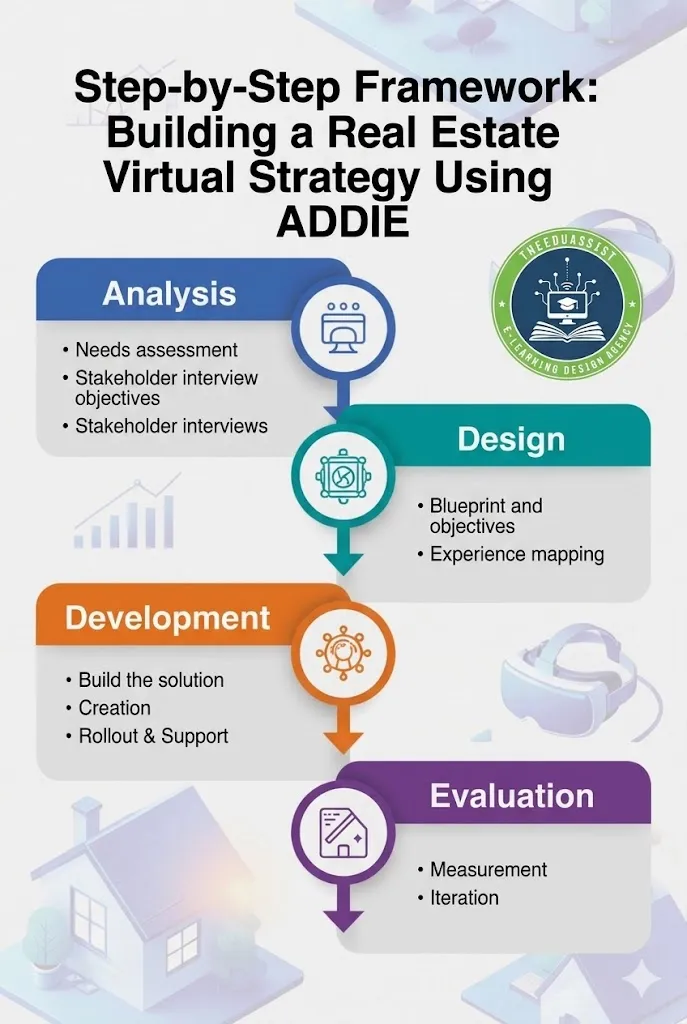
Step-by-Step Framework: Building a Real Estate Virtual StrategyUsing ADDIE
Follow this research-supported ADDIE adaptation, tailored for real estate VR/AR initiatives.
1. Analysis (Needs Assessment)
Conduct thorough front-end analysis:
- Learner/ Stakeholder Analysis: Identify agent skill gaps (e.g., virtual selling, remote client management), buyer pain points (travel barriers, visualization difficulties), and organizational goals (reduce showings by 40-50%, increase conversion rates).
- Task Analysis: Break down key performances, such as conducting a virtual tour, handling objections, or evaluating property features.
- Technology & Context Review: Assess available tools (360° cameras, VR headsets, AR apps) and constraints (budget, bandwidth, accessibility).
Research shows successful VR adoption in real estate ties to high-engagement tasks like spatial understanding or simulated client interactions. TheEduAssist’s rapid needs analysis services excel at this phase for custom programs.
2. Design (Blueprinting Objectives & Experiences)
Define clear, measurable objectives using Bloom’s Taxonomy (e.g., “By the end of the module, agents will demonstrate the ability to guide a virtual tour while addressing three common buyer objections”).
- Map content to immersive elements: Use 3D models for exploration, AR overlays for customization, branching scenarios for decision-making.
- Incorporate presence and feedback: Design for high immersion while including reflective prompts and immediate corrective feedback.
- Ensure accessibility: Provide mobile/low-immersion alternatives alongside full VR.
Storyboarding should include leveled progression: basic navigation → guided tours → complex scenarios (e.g., multi-client virtual open houses). Design for emotional engagement—studies show VR induces stronger emotional responses that influence purchase intent.
3. Development (Building the Solution)
Collaborate with developers and subject-matter experts:
- Create assets: Photorealistic 3D scans, interactive hotspots, AI-driven avatars for guided tours.
- Integrate interactivity: Clickable elements for property details, virtual staging, or simulation of renovations.
- Author in compliant formats: Use tools supporting SCORM/xAPI for tracking in LMS platforms.
Iterative prototyping with user testing prevents common issues like VR discomfort. TheEduAssist’s rapid eLearning and AI-powered development accelerate this while maintaining quality.
4. Implementation (Rollout & Support)
- Phased Approach: Pilot with a small team or property type, then scale.
- Onboarding: Provide short tutorials on using headsets or web-based VR.
- Integration: Embed virtual experiences in existing websites, CRM systems, or training LMS.
- Support: Offer technical helpdesks and blended options (VR for deep immersion, AR for quick previews).
For sales, host guided multi-user VR sessions or send lightweight headsets to VIP clients. For training, blend self-paced modules with live virtual debriefs.
5. Evaluation (Measurement & Iteration)
Use Kirkpatrick’s levels or similar:
- Level 1 (Reaction): Surveys on immersion, ease of use, and satisfaction.
- Level 2 (Learning): Pre/post assessments of knowledge and skills.
- Level 3 (Behavior): Observe on-the-job application (e.g., reduced physical showings, improved close rates).
- Level 4 (Results): Track business metrics—time-on-market, conversion rates, training ROI.
Telemetry data from VR platforms (time spent, interactions, drop-off points) provides rich insights. Studies confirm VR’s value when rigorously evaluated, showing faster sales cycles and better alignment with buyer preferences.
Evidence from Research and Real-World Applications
- Sales Impact: Empirical studies using large real estate datasets find VR signals correlate with shorter listing times and higher profitability, particularly for efficiency in high-involvement purchases.
- Buyer Experience: Immersive VR elicits stronger emotional and psychophysiological responses than photo-based viewing, enhancing user experience and behavioral intentions.
- Training Effectiveness: VR improves spatial ability, knowledge retention, and sales skills by simulating real client interactions.
- AR Applications: Mobile AR enables real-time visualization of changes, saving time and costs while increasing engagement.
These findings align with broader edtech research on AR/VR in education, where immersive tools outperform traditional methods when grounded in sound design.
Challenges and Mitigation
Common barriers include:
- Cost and hardware access
- Motion sickness or cognitive overload
- Digital divide (not all users have VR headsets)
- Integration with legacy systems
- Measuring true ROI beyond novelty
Mitigations via ID:
- Hybrid approaches (web-based low-immersion + full VR)
- Scaffolding and gradual onboarding
- Accessibility audits and mobile fallbacks
- Pilot programs with clear metrics
- Partnering with experienced providers like TheEduAssist for controlled, brand-aligned development
How TheEduAssist Supports Your Real Estate Virtual Strategy?
TheEduAssist specializes in custom eLearning, instructional design, rapid development, and AI-enhanced solutions across industries including real estate and rental/property sectors. They help transform virtual tours and simulations into structured training programs or buyer education modules that drive measurable outcomes.
Their services include:
- Needs analysis and ADDIE-based course development
- Immersive content creation compatible with LMS platforms
- AI-powered personalization for adaptive learning paths
- Scalable solutions for agent certification, investor education, or client-facing virtual experiences
Whether you need VR agent training modules, AR staging tools integrated into learning paths, or full virtual strategy implementation, TheEduAssist ensures pedagogical rigor and business alignment.
What “Real Estate Virtual Strategy” Really Means?
Many real‑estate firms equate “virtual” with virtual tours, live‑streamed open houses, or social‑media‑driven lead‑generation funnels.
Academically, however, a virtual strategy in real estate education refers to the intentional integration of digital environments, simulations, and online interaction into learning pathways that mirror real‑world practice.
Key research‑informed ingredients include:
- VR‑aided site visits and 360° simulations to build “sense of place” and valuation skills.
- Asynchronous online discussion platforms that simulate client–agent conversations, deal‑analysis dialogues, and negotiation practice.
- Micro‑learning modules that break one‑hour property‑analysis lectures into 5–10 minute tasks with embedded checks.
For TheEduAssist, a Real Estate Virtual Strategy should therefore be defined as:
A structured, learner‑centered digital‑learning ecosystem that uses VR‑style visualization, scenario‑based tasks, and micro‑learning sequences to help real estate investors, brokers, and students experience, analyze, and act on property‑market decisions as they would in the physical world.
Aligning with Instructional‑Design Principles:
Instructional‑design research in educational technology repeatedly emphasizes three core principles: analysis, design, and evaluation (ADDIE‑style cycles), plus learner‑activity balance and authentic practice. For a Real Estate Virtual Strategy, you can translate these into:
2.1 Start with a Backward‑Design Approach
- Define target performance: “Can the learner independently evaluate a rental‑property deal in city X?”
- Work backward from that outcome to design tasks, simulations, and feedback loops.
2.2 Design for “Learning by Doing”
Studies of technology‑supported real estate education show that interactive discussion platforms, role‑play simulations, and VR‑assisted site visits significantly improve conceptual understanding and practical judgment. Translated into TheEduAssist’s context, this means:
- Turning a “How to analyze a property” module into:
- A micro‑video explaining the 3‑step valuation model.
- A virtual deal‑brief with downloadable spreadsheets.
- A branching‑video quiz that simulates “client asks: is this over‑priced?”
2.3 Scaffold Cognitive Load with Micro‑Learning
Higher‑education research on virtual learning recommends chunking content into 5–10 minute segments with immediate self‑checks, rather than long lectures. Virtual real estate learners perform better when they:
- First watch a 7‑minute explainer on cash‑on‑cash yield.
- Then apply it to a virtual property tour with embedded calculators.
- Finally receive feedback on whether their assumptions match market benchmarks.
3. Building the Core Pillars of Your Real Estate Virtual Strategy:
Based on instructional‑design and e‑learning research, a Real Estate Virtual Strategy for TheEduAssist should rest on four core pillars:
| Pillar | What It Means | Why It Matters |
|---|---|---|
| Pillar 1: Needs‑Driven Learning Pathways | Define learner segments (e.g., beginner investors, licensed agents, cross‑border buyers) and map to specific outcomes. | Prevents “one‑size‑fits‑all” content and increases relevance. |
| Pillar 2: Scenario‑Based Virtual Experiences | Use VR‑style walkthroughs, virtual open houses, and deal‑simulation dashboards. | Closers real‑world transfer and spatial understanding. |
| Pillar 3: Asynchronous Social‑Learning Architecture | Online discussion boards, peer‑reviewed deal‑submissions, and Q&A forums. | Maintains engagement beyond live sessions. |
| Pillar 4: Measurement‑First Design | Embed quick assessments, pathway analytics, and feedback loops into every module. | Enables continuous improvement of your virtual strategy. |
These pillars mirror best‑practice instructional‑design frameworks used in online real estate education and professional‑training programs.
4. Pillar 1: Needs‑Driven Learning Pathways for Estate Virtual Strategy:
Academic insight: Research on online real estate education and built‑environment programs shows that outcomes improve when instructors first map course design to learner profiles and professional roles (e.g., student vs. practicing agent vs. investor).
4.1 Segment Your Audience
For TheEduAssist, possible segments include:
- New York–based real estate investors needing practical, city‑specific deal‑analysis skills.
- Pakistani‑based learners interested in cross‑border US or UK real‑estate opportunities, often using asynchronous learning.
- Licensed agents seeking virtual open‑house training or online coaching certification.
Each segment should have its own virtual learning pathway (not just one course).
4.2 Map Outcomes to Micro‑Pathways
Instructional‑design research suggests using performance‑based learning outcomes such as:
- “Given a virtual property listing and market data, the learner can calculate gross rent multiplier and cash‑on‑cash yield within 10 minutes.”
- “After a VR‑aided site visit, the learner can identify three renovation risks and justify them in a written report.”
From these outcomes, TheEduAssist can build short micro‑pathways (3–5 lessons) that stack into longer certificates or masterclasses.
4.3 Use “Must‑Learn, Nice‑to‑Know, Per‑Request” Sorting
E‑learning research recommends structuring content so that:
- Must‑Learn = core calculations, regulations, and risk‑assessment steps.
- Nice‑to‑Know = advanced deal‑structuring, local‑market trivia.
- Per‑Request = niche topics accessible via bonus modules or 1‑on‑1 coaching add‑ons.
This keeps your virtual strategy lean and scalable, avoiding content bloat.
5. Pillar 2: Scenario‑Based Virtual Experiences
Academic insight: VR‑aided real estate courses and technology‑supported programs report improved “sense of value and place,” communication efficiency in property analysis, and transaction‑process understanding.
5.1 Use VR‑Style Visualization, Not Just 360° Tours
Many firms stop at panoramic tours. Instructional‑design research, however, emphasizes that VR is most effective when embedded in learning tasks:
- Task‑driven VR scenarios
- Example: A virtual walkthrough of a New York brownstone with embedded hotspots:
- Click “roof” → see structural notes and repair‑cost estimates.
- Click “basement” → see demo of zoning issues.
- After each hotspot, the learner answers a short question or updates a deal‑sheet.
- Virtual “deal rooms”
- A browser‑based dashboard where learners assemble financing terms, rent assumptions, and rehab costs, then compare their virtual deal with a benchmark portfolio.
For TheEduAssist, this means integrating VR‑style widgets inside your Kajabi or Skool course dashboards, not just posting external links.
5.2 Simulate Open Houses and Negotiations for Real Estate Virtual Strategy:
Research on virtual marketing and real‑estate education shows that virtual tours and self‑guided walkthroughs improve buyer engagement and time‑on‑property metrics. You can extend this into instructional design by:
- Creating virtual open‑house simulations where learners:
- Role‑play as an agent answering a buyer’s objections.
- Receive feedback on whether their responses align with data‑based negotiation research.
- Building branching‑video deal‑virtues
- If the learner chooses “I’ll over‑bid by 10%,” the system shows a comparative‑market‑analysis (CMA) dashboard and explains the risk.
- If they choose “I’ll wait for seller’s counteroffer,” the system scaffolds a counter‑offer‑construction checklist.
6. Pillar 3: Asynchronous Social‑Learning Architecture
Academic insight: Technology‑supported real estate education increasingly relies on online discussion platforms to create cross‑jurisdiction, interdisciplinary learning environments. For asynchronous‑learning‑heavy markets like Pakistan, this is critical.
6.1 Replicate “Deal‑Room” Culture in Virtual Classrooms
Research on virtual higher education and property‑technology programs shows that structured discussion threads linked to case studies improve learners’ analytical maturity and confidence. For TheEduAssist:
- Every module should end with a discussion prompt tied to a virtual property:
- “Review the attached virtual listing and argue whether this is an over‑priced or under‑valued asset.”
- Learners respond with short written notes, then peer‑evaluate two others using a rubric.
6.2 Use Role‑Based Forums
Instructional‑design research suggests that learners develop deeper understanding when they take on professional roles (agent, investor, lender, inspector). You can design:
- Role‑tagged discussion boards
- #InvestorCafe: Deal‑submission threads.
- #AgentAcademy: Virtual‑open‑house debriefs.
- #DataDesk: Market‑data analysis discussions.
Each role receives tailored prompts pushing them to apply specific skills (e.g., financing, risk‑assessment, negotiation).
6.3 Build Virtual “Learning Communities” for Real Estate Virtual Strategy:
Higher‑education research on virtual learning emphasizes that persistent online communities (not just one‑time courses) improve retention and professional identity. For TheEduAssist, this maps to:
- A Skool or Kajabi community wrapped around your Real Estate Virtual Strategy.
- Regular “virtual deal‑review” sessions as cohort‑based events.
- Persistent resource libraries (e.g., virtual deal‑templates, VR‑tour links, checklists).
7. Pillar 4: Measurement‑First Design and Continuous Improvement
Academic insight: Studies of online real estate and property‑technology education show that embedding assessments and analytics into the design phase improves course quality and learner outcomes.
7.1 Bake in Embedded Assessments
Instructional‑design research recommends frequent, low‑stakes assessments instead of one‑time final exams. For TheEduAssist’s Real Estate Virtual Strategy:
- Every module should include:
- 1–3 quick checks (multiple‑choice or short‑answer) after micro‑lessons.
- 1 applied task (e.g., “Upload your deal‑sheet for this virtual property”).
- Use quiz‑tool and LMS analytics to identify:
- Which concepts are repeatedly missed.
- Which VR‑style activities generate the highest engagement.
7.2 Use Learning Pathway Analytics for Real Estate Virtual Strategy:
Research on virtual learning dashboards suggests that visual progress‑tracking (pathways, badges, completion bars) improves motivation. For TheEduAssist:
- Design a Real Estate Virtual Pathway Matrix that shows:
- Stage 1: Foundations (finance, markets, regulations).
- Stage 2: Deal‑Analysis Skills (virtual tours, CMAs, cash‑flow modelling).
- Stage 3: Advanced Flows (portfolio‑building, virtual‑open‑house coaching).
- Each completed module unlocks a visual badge or milestone in the community.
7.3 Close the PDCA Loop (Plan–Do–Check–Act)
Higher‑education and e‑learning research encourages continuous improvement cycles:
- After each cohort, analyze:
- Quiz scores.
- Community engagement metrics (posts, replies, time‑on‑VR tasks).
- Use this data to tweak:
- Task difficulty.
- VR‑scenario length.
- Support materials (e.g., downloadable checklists).
8. Integrating Your Real Estate Virtual Strategy into TheEduAssist’s Business Model
Academic insight: Research on virtual marketing and technology‑enabled real‑estate practices shows that digital strategies increase perceived value, shorten decision‑time, and boost lead‑quality. Translating this into TheEduAssist’s context:
- A Real Estate Virtual Strategy is not just a course feature; it becomes a differentiator for your brand.
- Virtual‑driven education positions TheEduAssist as a design‑savvy, research‑based training partner rather than a generic content provider.
8.1 Product‑Level Integration
- Bundle Real Estate Virtual Strategy assets into:
- “Investor Starter Pathway” (asynchronous modules + VR‑style walkthroughs).
- “Virtual Open‑House Mastery” (branching‑video simulations + role‑play forums).
- Offer modular add‑ons:
- Extra VR‑style walkthrough libraries for specific cities.
- Advanced analytics dashboards for coaching‑clients.
8.2 Marketing‑Level Integration
Research on virtual marketing and real‑estate‑information dissemination shows that interactive, immersive content outperforms static listings. TheEduAssist can:
- Use short VR‑style snippets from courses as lead‑magnets:
- “Experience a virtual walkthrough of a New York rental property and see how we calculate yield.”
- Position its Real Estate Virtual Strategy as a learning‑science‑backed approach, not just “online courses.”
8.3 Coaching & High‑Touch Services
Instructional‑design research notes that virtual strategies perform best when blended with coaching or mentoring. For TheEduAssist, this means:
- Offering virtual deal‑coaching sessions where learners bring their own VR‑style deal‑sheets.
- Creating VIP cohorts that combine pre‑recorded modules with live review of virtual property analyses.
9. Research‑Backed Best Practices for Your Real Estate Virtual Strategy:
Drawing from real estate education, virtual‑learning, and instructional‑design research, here are 7 best practices you can apply directly at TheEduAssist:
- Start small, then scale
- Build one pilot micro‑pathway (e.g., “New York Rental Deal Analysis”) using VR‑style visualization and micro‑learning, then expand.
- Use VR‑style experiences as tasks, not eye‑candy
- Every 360° or VR‑activity must be paired with a learning task and a feedback loop.
- Write assessments before you script videos
- Backward‑design research shows that defining assessments first sharpens content focus.
- Create role‑based discussion prompts
- Assign learners roles (investor, agent, lender) to deepen professional identity and critical thinking.
- Limit live‑only sessions
- Asynchronous research recommends 70–80% self‑paced content, 20–30% live or cohort‑based interaction.
- Measure time‑on‑VR tasks, not just quiz scores
- Engagement metrics help identify which virtual experiences are most effective.
- Update your virtual strategy every 6–12 months
- Technology‑and‑learning research shows that virtual education ecosystems must evolve with tools and learner expectations.
10. Practical Roadmap for TheEduAssist Real Estate Virtual Strategy:
Using instructional‑design and real estate education research, here is a 12‑month roadmap to build your Real Estate Virtual Strategy:
Month 0–3: Foundation & Research for Real Estate Virtual Strategy
- Audit existing TheEduAssist courses and learner data.
- Identify one niche (e.g., New York rental‑investor pathway) as the pilot.
- Map learner segments, outcomes, and core assessments.
Month 4–6: Prototype Design
- Build a 3–5‑lesson micro‑pathway with VR‑style walkthroughs and micro‑learning.
- Design role‑based discussion prompts and rubrics.
- Test with a small beta cohort and collect analytics.
Month 7–9: Launch & Iterate Real Estate Virtual Strategy
- Soft‑launch the Real Estate Virtual Strategy as a flagship pathway.
- Run one cohort fully, then refine modules, assessments, and VR‑experiences.
- Integrate feedback loops and pathway‑tracking visuals.
Month 10–12: Scale & ProductizeReal Estate Virtual Strategy
- Package the virtual pathway into a core product line (e.g., “TheEduAssist Virtual Real Estate Academy”).
- Add city‑specific VR‑libraries and add‑on coaching tiers.
- Document the strategy as a repeatable design‑system for future verticals
Conclusion:
Building a successful Real Estate Virtual Strategy requires more than advanced technology. It demands a strong foundation in instructional design. Using systematic frameworks like ADDIE, real estate companies can create immersive VR and AR experiences that improve buyer engagement, speed up sales cycles, reduce physical showings, and deliver effective agent training.
For expert support, TheEduAssist provides specialized instructional design and custom eLearning solutions tailored for the real estate sector. Their research-informed approach turns virtual tools into measurable business results instead of short-term novelties.
The future of real estate is virtual. Companies that combine sound instructional design with VR, AR, and 3D technologies today will lead the market tomorrow. A well-executed Real Estate Virtual Strategy is no longer optional it has become a necessity.
References:
Spatioti, A. G., et al. (2022). A Comparative Study of the ADDIE Instructional Design Model in Distance Education. Information, 13(9), 402. https://www.mdpi.com/2078-2489/13/9/402 (Discusses ADDIE model effectiveness in online and technology-enhanced learning environments). https://www.mdpi.com/2078-2489/13/9/402
Mathur, J. (2023). Designing immersive experiences in virtual reality for real estate and architectural visualization. Additive Manufacturing Letters. ScienceDirect. (Explores VR design for immersive property experiences). https://www.sciencedirect.com/science/article/am/pii/S2214860423004888
Richards, D., et al. (2015). A Comparison of learning gains when using a 2D simulation tool versus a 3D virtual world. Computers & Education. ScienceDirect. (Compares 2D vs. 3D/VR learning effectiveness). https://www.sciencedirect.com/science/article/abs/pii/S0360131515000780
Yu, W., et al. (2021). The Effect of Virtual Tours on House Price and Time on Market. Journal of Real Estate Literature. (Examines how virtual tours affect sales price and time-on-market). https://www.sciencedirect.com/science/article/am/pii/S2214860423004888
Anderson, K. C., et al. (2022). The Impact of Virtual Marketing Strategies on the Price-TOM Relationship. Journal of Real Estate Research. PMC. (Analyzes virtual tours’ role in real estate transactions). https://pmc.ncbi.nlm.nih.gov/articles/PMC9243859/
Meng, Z., et al. (2025). Study on Virtual Reality Tours in Real Estate (Information Systems Research). UT Dallas research summary. (Shows VR tours reduce time-on-market significantly). .https://news.utdallas.edu/business-management/virtual-reality-tours-real-estate-2025/
Systematic review on Augmented Reality and Virtual Reality in Education (2025)ResearchGate / ScienceDirect sources. (Covers benefits, challenges, and applications of AR/VR in learning). Kirkpatrick Partners. (n.d.). https://www.researchgate.net/publication/395031332_Augmented_reality_and_virtual_reality_in_education_A_systematic_narrative_review_on_benefits_challenges_and_applications
The Kirkpatrick Model – Four Levels of Training Evaluation. (Standard framework for evaluating VR training effectiveness: Reaction, Learning, Behavior, Results). https://www.kirkpatrickpartners.com/the-kirkpatrick-model/
Carnell, S., et al. (2022). Using a Virtual Human Scenario to Measure Training Effectiveness. Frontiers in Virtual Reality. (Applies Kirkpatrick Model to VR-based training). https://www.frontiersin.org/journals/virtual-reality/articles/10.3389/frvir.2022.810797/full
Troncoso, I. (2023). Are Virtual Tours Still Worth It in Real Estate? Evidence from 75,000 Home Sales. Harvard Business School Working Knowledge. (Analyzes real-world impact of virtual tours post-pandemic).https://www.library.hbs.edu/working-knowledge/are-virtual-tours-still-worth-it-in-real-estate-evidence-from-75000-home-sales
Frequently Asked Questions (FAQs)
What is a Real Estate Virtual Strategy?
A Real Estate Virtual Strategy is a comprehensive plan that uses Virtual Reality (VR), Augmented Reality (AR), 360° tours, and 3D interactive models to enhance property marketing, buyer experiences, remote sales, and agent training. It reduces reliance on physical viewings while improving decision-making and engagement.
Why is instructional design important in a Real Estate Virtual Strategy?
Instructional design ensures virtual tools are educationally effective, not just visually impressive. It applies proven frameworks like ADDIE to create structured experiences that drive skill development, better buyer decisions, and real business outcomes such as faster closings and higher conversion rates.
How can VR and AR benefit real estate agents and buyers?
For buyers, VR/AR offers realistic property walkthroughs from anywhere. For agents, it provides safe practice for sales scenarios, objection handling, and virtual staging. Research shows these tools shorten time-on-market and increase buyer confidence.
What role does TheEduAssist play in building a Real Estate Virtual Strategy?
TheEduAssist specializes in custom eLearning and instructional design. They help real estate firms create effective VR/AR training modules, buyer education programs, and immersive virtual tours that are pedagogically sound and aligned with business goals.
How long does it take to develop a Real Estate Virtual Strategy?
Using the ADDIE framework, a typical project takes 3–6 months depending on scope. TheEduAssist can accelerate timelines through rapid development methods while maintaining high quality.
Is VR training more effective than traditional real estate training?
Yes, when properly designed. Immersive VR delivers higher knowledge retention, better spatial understanding, and stronger skill transfer. It excels in experiential scenarios that are difficult to replicate in real life.
What are the biggest challenges in implementing a Real Estate Virtual Strategy?
Common challenges include high costs, user adoption, motion sickness, accessibility, and measuring ROI. These can be addressed with hybrid (web + VR) solutions, strong instructional design, and phased rollout.
How can I get started with a Real Estate Virtual Strategy?
Start with a professional needs assessment. TheEduAssist offers expert consultation to identify your goals, recommend suitable technologies, and design a customized roadmap using instructional design best practices.
Authored By: Atiqa Sajid http://www.linkedin.com/in/atiqa-sajid-747b57137