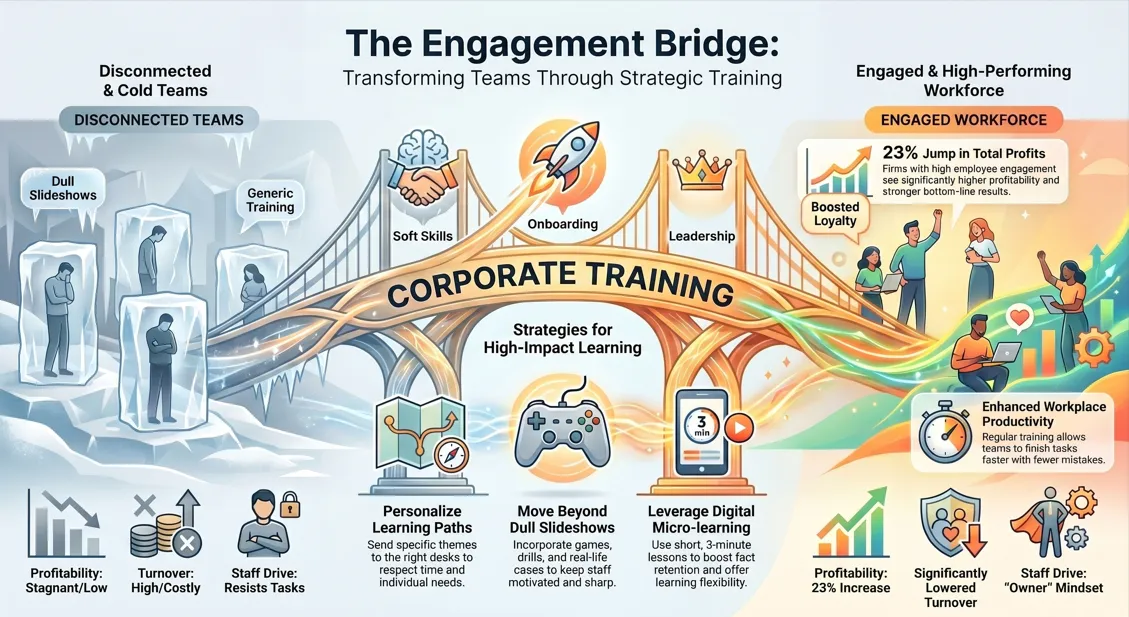

We drew inspiration from a conversation on Reddit (https://www.reddit.com/r/RethinkingEdTech), where educators, instructional designers, and EdTech professionals questions whether AI is truly transforming learning or simply digitizing traditional models.
The EdTech sector has never been screeching.
AI-driven platforms are scalable to personalization, predictive learning analytics dashboards purport to claim. Adaptive systems proposed to be able to cognize all learners. Since the entire LMS ecosystem is a niche AI authoring tool, the innovation seems insatiable.
But there is one underlying question:
Are we really changing the way people learn, or is it merely that we are just digitalizing old ways of instruction?
This tension is likely to have been felt by you, should you work in the field of education, corporate L&D, product design, or instructional design. Completion rates increase, dashboards are impressive, and engagement metrics are healthy; however, there are still performance gaps. Students continue to have application problems. There is an irregular transfer of skills. Motivation fluctuates.
This paper will discuss:
- The structural flaws of the current AI-driven EdTech environment
- Potential things we are missing
- A problem-solving approach based on instructional psychology, learning science, and strategic design thinking
How EdTech Produces the Illusion of Innovation
Platforms such as Coursera, Udemy, and enterprise LMS providers, including Moodle, have become increasingly available to digital learning around the world over the last decade. In recent years, AI-driven systems and generative tools have enhanced the speed at which content is created faster than ever.
And transformation is not speed.
Most of the modern AI-driven learning systems are based on conventional learning designs:
- Linear course modules
- Passive video consumption
- Multiple-choice assessments
- Completion-based tracking
We have, in fact:
- Digitalized the classroom lecture model
- Automated slide decks
- Scaled fixed curricula
The learning architecture is one thing that we have not redesigned on a regular basis.
The basic assumptions have not violated:
- Exposure to content is learning
- Assessment equals recall
- Engagement equals clicks
- Recommendation engines = personalization
What Does It Indeed Mean to Have AI Understand a Learner?
Another marketing assertion that has been repeated the most in AI in education is that systems are capable of understanding learners.
What, however, is the cognitive meaning of understanding?
Human learning shaped by:
- Prior knowledge schemas
- Metacognitive awareness
- Emotional states
- Motivation cycles
- Social identity
- Contextual constraints
Modern AI personalization can be based on behavioral data:
- Time spent on task
- Quiz accuracy
- Interaction frequency
- Content preference
This is not understanding. It is pattern detection.
Genuinely learner-centered AI system, such a system should have to combine:
- Cognitive load theory
- Self-determination theory
- Spaced retrieval models
- Transfer-based evaluation
- Application measures in the context
Unless the learning science is integrated into designing the system, AI is still a recommendation algorithm that is placed over the conventional e-learning systems.
The Places Where Current EdTech Approaches Are Falling Short
Content Over Competence
Content libraries are costly to most organizations. Courses are made available in thousands. However, there is still a marginal performance improvement.
Why?
The exposure to information is not necessarily the same as the acquisition of skills.
Competence requires:
- Deliberate practice
- Feedback loops
- Real-world simulation
- Reflection cycles
- Error-based learning
When the amount of content in learning systems is more important than the experience design, the outcome is superficial learning.
Metrics That Mislead
Dashboards filled with:
- Completion rates
- Frequency of logins
- Quiz scores
These are administrative measures, not performance measures.
Measures that are rarely taken within organizations are:
- Behavioral change
- Use in the workplace setting
- Retention after 90 days
- Transfer across tasks
When we maximize on the wrong measures, systems that promote conformity as opposed to expansion will be developed.
Overspecification of Automation at the Cost of Human Anchoring
In automation with AIs, friction in operations is decreased. Nevertheless, learning is not entirely mechanical. It is deeply psychological.
Humans learn through:
- Dialogue
- Social modeling
- Emotional reinforcement
- Mentorship
- Contextual storytelling
Transactional interaction can be minimized by completely eliminating the human layer.
EdTech should not be a human-free field in the future. It should be human-augmented.
The Ceaseless Dimension That We Are Missing
Learning is not simply a mental activity. It is a reconstruction of identity.
When a learner acquires a new skill, they do not think that they are simply learning something; they are redefining their own identity.
The existing AI-based systems seldom consider:
- Confidence building
- Fear of failure
- Imposter syndrome
- Motivation decay
- Social comparison
These are factors that have a drastic impact on the learning results.
Unless technology-based platforms emphasize psychological variables and content sequencing, engagement will not increase despite an advanced level of technology.
Scaling vs. Impact: Are We Designing to Be Scalable?

Scalability is commonly favored in corporate Learning and Development. Thousands of learners have to be dealt with by systems. The content should be able to be deployed fast.
Scalable design is not necessarily effective design.
True impact requires:
- Pre-assessment with diagnostic evaluation
- Progression of the adaptive challenge
- Comprehensive feedback structure
- Reflections associated with actual work assignments
- Time series cycles of reinforcement
These functions can be supported with the help of AI only in the case that technology is guided by instructional design rather than vice versa.
What Learners Are Really Searching
Analyzing the tendencies in search behavior, learners are more and more seeking:
- “Practical AI learning 2026”
- How to transfer skills post online course
- The best instructional design strategies to use in engaging
- AI effectiveness in corporate training
- Retention of learning through the Internet
Dissatisfaction found in these searches.
More content is not what people are requesting. They are seeking:
- Application
- Visibility
- Quantifiable growth
This signals an opportunity.
A Problem-Solving Framework of Rethinking EdTech
We have to have a structural change in case we are ambitious about changing learning in the era of AI.
Step 1: It Begins with Performance Gaps, Not Content Libraries
Determine what learners are unable to do and not what they have not read.
Start with the design backward.
Step 2: Integrate Sciencing into AI Systems
Integrate:
- Spaced repetition
- Retrieval practice
- Scenario-based simulations
- Reflective journals
- Contextual micro-challenges
These are the dynamics that AI is supposed to arrange.
Step 3: Redefine Personalization
It should not be personalization, as in recommended videos.
It should mean:
- Skill-gap diagnosis
- Calibration of cognitive challenge
- Emotional support nudges
- Context-based practice assignments
That calls for interdisciplinary cooperation between:
- Instructional designers
- Psychologists
- Data scientists
- L&D strategists
Step 4: Measure What Matters
Shift metrics toward:
- Improvement of task performance
- Time-to-competence
- Behavioral change
- Retention stability
- Cross-context transfer
In the absence of redefining success indicators, surface engagement optimization will continue.
How AI Can Be Used in the Future: Human-Centered, Evidence-Driven, Performance-Focused
AI is not the problem.
Possibly, unquestioned assumptions are.
Technology in education should incorporate:
- Cognitive science
- Behavioral psychology
- Performance indicators in an organization
- Ethical AI governance
- Human facilitation
This is not about increased automation.
The aim is a higher level of capability development.
In case lecture-based models are recreated online, students will still be left unfocused no matter how advanced the technology of the platform becomes.
The Reason Why This Conversation Is So Important Now
The market of EdTech is expected to grow fast in the next five years. Organizations are also spending a lot of money on AI-based training systems.
However, reinvestment without redesign is a chance to strengthen inefficiencies of scale.
This is the time to take a pause and ask:
- Do we actually create learning ecosystems that increase human performance?
- Or do we maximize administrative convenience?
Summary: Before We Scale, It Is Time to Rethink
There is unmatched potential in the age of AI.
Technology in itself does not change learning.
Transformation requires:
- Instructional integrity
- Psychological insight
- Strategic measurement
- Human-centered design
Faster content production will not be the true competitive advantage if you are building platforms, creating learning experiences, or leading L&D strategy.
It will be the measurable performance impact based on learning science.
At EduAssist, the next generation of digital learning is believed to require a combination of AI, deep instructional design principles, and human performance strategy. When your organization is prepared to move beyond superficial engagement metrics and build systems that truly change capability, the journey starts here.
Frequently Asked Questions
What Do You Consider to Be the Greatest Problem with AI-Powered EdTech?
An excessive focus on automation and content scale has been placed without integrating cognitive science and performance-based evaluation into system design.
Is AI Personalization Beneficial to Learning?
AI can enhance learning when personalization is based on skill-gap analysis, adaptive progression of challenges, and reinforcement cycles, rather than only recommendation algorithms.
Why Are Numerous Online Courses Not Making a Long-Lasting Impact?
Because information delivery is prioritized instead of deliberate practice, contextual application, and long-term retention strategies.
What Can Corporate L&D Do to Enhance Training Effectiveness?
Training programs should be aligned with measurable business performance metrics, spaced practice should be incorporated, and AI-assisted systems should be combined with human facilitation.
Is the Traditional LMS Becoming Obsolete?
Traditional LMS platforms are not obsolete, but they must evolve into performance enablement ecosystems integrated with AI and learning science.