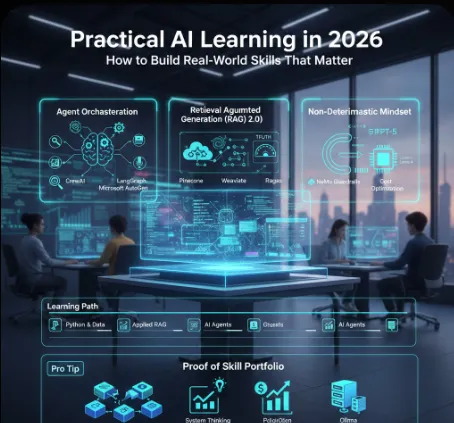
The AI is not a new tendency anymore. It is highly embedded in the daily business in 2026. AI is employed to analyze search intent and automate content pipelines by marketing teams. It is used by business leaders to make predictions and decisions. AI systems allow content creators to expand production without reducing quality.
However, even with its ubiquity, a significant number of professionals have not been sure of how they could learn AI in a manner that would ultimately result in practical application. There are a plethora of tutorials, certifications, and tool demonstrations on the internet. Yet, useful ability is not a result of exposure. It derives from organized practice.
The best approach to studying AI in 2026 is to consider it as a business ability and not as a technical interest.
Transitioning from focusing on AI as a business skill, it’s important to recognize the Confusion with AI Learning.
Organizations like OpenAI, Google, and Anthropic have made the AI ecosystem grow at a high rate. Advanced AI is now accessible to non-technical users, and tools such as ChatGPT and Claude have enabled this. In the meantime, systemic search-based applications like the Perplexity AI are altering information discoveries and corroborations.
Professionals can be caught in two traps with all the available tools and changing features. Others read interminable theory without putting it into practice. The other people try things randomly without knowing the logic behind them. Nor does one construct transferable, enduring ability in either.
The practical AI competence needs form and practice.
Artificial Intelligence is Trained by Process, Not Input.
Quite a few newcomers pay attention to better prompts. Although prompt engineering is relevant, it is only a minor aspect of applied AI. In the business context, artificial intelligence is not commonly applied to individual outputs. It is ingrained in processes.
Think of a marketing department that is trying to enhance organic visibility. Some of the possible applications of AI include clustering keywords, competitor analysis, outlines, writing optimized content, and performance tracking. These steps are connected. The workflow is important, but not the personal prompt.
Once you start to learn to design multi-step AI systems that make a connection between research, production, and optimization, then you start to think like a strategist as opposed to a user of the tool. This shift is critical in 2026.
Begin with Background Knowledge.
You do not have to graduate into a machine learning engineer. Nevertheless, the simplest knowledge of the mechanism of AI models can significantly enhance actual performance.
Large language models respond to questions depending on the probabilities learnt on huge datasets. They are not humanly aware of information. They predict patterns. This is the reason why there are hallucinations, and the reason validation is crucial.
Knowledge of the context windows, token limits, model bias, and data privacy will confer credibility and minimise operational risks. Enterprises appreciate the services of professionals knowledgeable of the capabilities and shortcomings of AI systems.
This theoretical basis promotes EEAT principles. You will be more reliable and authoritative when you demonstrate experience and experience with how the AI works.
Select a single Industry Application and Go Deep.
AI skills are contextual. General awareness of AI tools is unworthy compared to implementation in the domain.
When working in marketing, you should look at the development of AI-based content systems, audience segmentation models, or automated reporting workflows. In case you are in the business operations field, you create AI-assisted dashboards, automation systems of documentation, or forecasting models. In case you are a content creator, create research acceleration pipelines and repurposing frameworks.
The depth brings about differentiation. Employers are not looking after generic AI enthusiasts. They seek professionals who can incorporate AI into systems that can generate revenue or enhance their efficiency.
Create Projects in Real Life to Existing Measurable Problems.
The most viable means of acquiring AI is to address a specific problem. As an illustration, suppose that you want to triple blog conversions. You can create an entire workflow of AI-generated optimization, as opposed to merely requesting AI to write you a better article.
You can apply AI to search intent, determine content gaps, create authority-based outlines, write content in accordance with the rules of SEO, optimize the EEAT signals, and optimize calls-to-action. In the long term, you calculate the growth of the traffic, the engagement rates, and the enhancement of the conversions.
It is an educational process that cannot be learned through a single tutorial. It cultivates analytical, prompting, performance, and iterative discipline. These are the competencies that businesses invest in.
Are AI Certifications Ever Worth It?

The certification programs by AI may be worthwhile, though there are certain conditions. When a certification emphasizes much on theory and does not have practical projects, its practical effect might be small. But a program that is well organized and based on use cases and necessitates the construction of workflows that are deployable can hasten the learning.
The actual issue is not whether there is a certification or not. Whether it goes between knowledge and execution.
By the year 2026, the hiring managers are likely to be more interested in portfolios than credentials. An established AI project with quantifiable results may be superior to a certificate. Nonetheless, the formal programs are capable of offering guidance, structures, and authenticity along with the application in practice.
The 10 AI Skills that Will Impact the Future (2026).
Though AI tools are constantly improving, multiple core competencies add value regularly. The design of workflow automation is becoming significant since organizations desire to have scalable systems as opposed to single outputs. Efficiency and quality of output are improved due to strategic prompt engineering that aims at the achievement of business objectives. Integration of AI and SEO The integration of AI and SEO is increasingly becoming a critical issue because the discoverability of AI-generated summaries and search interfaces is affected. Governance awareness can be used to implement in a responsible and compliant manner.
Most importantly, professionals are singled out by their performance optimization. Testers, measurers, and refiners create AI outputs that distinguish practitioners and non-practitioners.
Time of becoming proficient?
Real-world AI skills are reliant on practice. Most of the professionals can develop basic literacy within one month. They can come up with working workflows within three months of guided experimentation. In six months of targeted implementation, they will be able to show tangible results.
The rate of development is not as much talent-driven; it is more disciplined.
AI Skills in Business in the Future
AI is progressively becoming a tool of novelty to be used and is becoming an operational layer as part of the business infrastructure. Organizations are creating functions that are directly concerned with AI integration, workflow design, and AI-driven strategy. Outward acquaintance will not suffice much longer.
Individuals who know how to integrate AI devices in an integrated way, quantify results, and streamline processes will be at a great advantage.
It is not about trend following that AI should be learned in 2026. It concerns the creation of repeatable ability that will lead to productivity, decision-making, and revenue performance.
Conclusion
There is no purely experimental and purely theoretical way of learning AI skills to use in real-world in 2026. It is performance-oriented, project-oriented, project oriented and structured.
Start with background knowledge. Choose a domain. Build real workflows. Measure results. Refine continuously.
The journey can be facilitated using certifications, provided they focus on practical learning. However, sustainable expertise is informed by finding real-world solutions and recording quantifiable change.
AI is no longer optional. It belongs to professional literacy. Individuals who treat it strategically will not only be able to adjust to the AI-based economy, but they will be able to influence it.
Frequently Asked Questions
Is AI challenging for non-technical professionals to learn?
No. The majority of AI tools today are user friendly by business consumers. Nevertheless, reliability and strategic usage are enhanced by the knowledge of fundamental principles.
Am I required to know programming?
Simpler tools can be used to create many valuable AI workflows that consume no or low-code programming, although customization is often increased.
What can I do to demonstrate my AI talent to employers?
Construct and report actual projects that have quantifiable results. The results obtained are more significant than theoretical information.
What is the greatest failure of beginners?
Excessive dependence on AI outputs without control and incorporation into formal processes.
Is it possible to master AI through experimentation?
It requires experimentation to be performed, but until it is structured and has some goals to be achieved, the progress will remain haphazard.